You know how to install an operating rhythm. You've done it a dozen times: set the goals, build the scorecard, get the weekly meeting in the calendar, and teach a leadership team to run it. That part is craft, and you're good at it.
The hard part isn't installing one rhythm. It's running six at once — and knowing, on a Monday morning, which of the six is quietly falling apart.
Sound familiar?
- Every client runs a slightly different version of your system, because each one started from whatever tool they already had.
- You rebuild the same scorecard structure from scratch at the start of every engagement.
- Between sessions, you have no idea whether the weekly meeting actually happened.
- Your notes for six companies live across a laptop, four Google Docs, and your memory.
- You find out a client has drifted at the monthly session — three weeks after it started.
- When you roll off, the rhythm decays within a quarter, and nobody calls it your fault, but you know.
- You bill for judgement and spend your evenings on setup, chasing numbers, and rebuilding agendas.
Why client rhythms decay
The rhythm is rented, not owned. If the weekly meeting only happens when you're on the call, you haven't installed a system — you've sold attendance. It feels like success while you're engaged, and it evaporates about six weeks after you leave. The test is brutally simple: did week four happen without you?
The tool belongs to them; the system belongs to you. Their work lives in a project tool you don't have a seat in. Your system lives in a spreadsheet template you carry from client to client. The two never merge, so the operating rhythm exists in a document nobody at the company opens between meetings.
Weekly discipline needs weekly visibility, and you show up monthly. This is the structural problem. A rhythm is a weekly thing; your engagement is a monthly thing. Everything that goes wrong, goes wrong in the gap — and by the time you see it, you're spending your session on archaeology instead of judgement.
The blueprint
Six pieces. The first three are about what you install; the last three are about what happens when you're not in the room.
One cadence, installed identically every time
Same meeting shape, same day-of-week discipline, same scorecard structure at every client. When the machinery is identical, you can walk into any client's meeting and know exactly where you are — and your brain is free for the actual problem.
A scorecard that starts from a template, not a blank page
Eight to twelve metrics, direction and target on every line, one owner each. You'll customise the metrics for a legal practice versus an MSP — but never the structure. Rebuilding the frame each time is unbillable work you keep volunteering for.
One owner per commitment — and it isn't you
Your name should appear on almost nothing. Every metric, goal, and issue belongs to somebody who works there. The moment you own a scorecard line, you've become staff, and the rhythm now depends on your calendar.
The meeting happens without you
Facilitate the first review, co-facilitate the second, observe the third. By the fourth you should be a guest. This sequence is the entire difference between a rhythm you installed and a meeting you host.
Visibility between sessions
You need to know on Monday which client skipped the week, whose scorecard fell off a cliff, and which issue has now survived four meetings. Not because you'll intervene every time — but because it changes what you walk into the monthly session prepared to do.
A handoff designed on day one
In the scoping call, before the engagement starts, name the person who runs this when you're gone. Rhythms that were never explicitly handed over decay by default — and the ones that survive become your best referrals.
What to standardise, what to leave alone
The instinct to customise everything for each client is how a practice stops scaling. The instinct to standardise everything is how you lose the room. The line sits in a specific place:
| Standardise ruthlessly | Customise every time |
|---|---|
| The meeting shape and its stages | The vocabulary — use their words for goals, metrics, and issues |
| Scorecard structure: owner, direction, target, 13-week trail | Which metrics belong on it, and what "good" looks like |
| The rule of one named owner per line | Who's in the room, and how blunt you can be in it |
| The 30-day install sequence | Pace — some teams need six weeks before you step back |
| Carrying unsolved issues forward, visibly | How hard you push on a carried issue, and when |
| Ending on commitments with names attached | The quarterly session format and how much you facilitate |
The first 30 days
- Day 0Scoping callAgree who's in the room, how long you're engaged, and what "done" looks like. Name the person who runs the meeting after you leave — on day zero, not month six. This single question changes how the whole engagement is built.
- Week 1Install sessionHalf a day. Set 3–5 goals with one owner each, draft the scorecard, and put the weekly meeting in the calendar as a recurring invite before anyone leaves the room.
- Week 2You facilitateRun the first review yourself, narrating why each stage exists. Expect the scorecard to be half empty — assign owners to the gaps rather than filling them in yourself.
- Week 3You co-facilitateTheir champion takes the scorecard and goals; you take issues. Correct the shape of the meeting, not its content. Kill any metric nobody could source twice.
- Week 4You observeCamera on, mouth shut. This is the session that tells you whether the rhythm is installed or rented — and it's worth more diagnostic information than any survey.
- Day 30Sponsor checkpointWalk the three weeks: completion rate, scorecard health, issues raised versus solved. Then agree your own cadence from here — usually monthly. Going monthly before week four has held is one of the quietest ways a good engagement fails.
What software does a fractional COO actually need?
Less than the long lists of fractional COO tools suggest. To run the rhythm itself, you need four things at every client, whichever tool they live in:
- A shared scorecard. Eight to twelve numbers, one owner each, with a target and a 13-week trail.
- A weekly meeting runner. The same stages every week, with last week's commitments carried forward.
- An issues list that outlives the meeting. Ranked, visible, and solved into a to-do with a named owner.
- A portfolio view. Which client skipped the week, whose scorecard slipped, which issue is four meetings old.
A lot of software for fractional COOs is practice management — proposals, invoicing, pipeline — and that belongs elsewhere. Vetta covers the first three inside each client's workspace today, and you can join each one on a free seat — read-only for now. The fourth, the portfolio view, is the part still in design.
Seeing across all of them
Everything above is one client. The thing no template solves is the portfolio view: five or ten companies, each running a weekly rhythm, and you needing five minutes on a Monday to know where to point your attention.
The pack includes a portfolio tab that does this in a spreadsheet — last review date, streak, scorecard health, carried issues, and a flag that turns when a client goes quiet. It works, and you should start there.
It's also the piece of Vetta we're designing for guides:
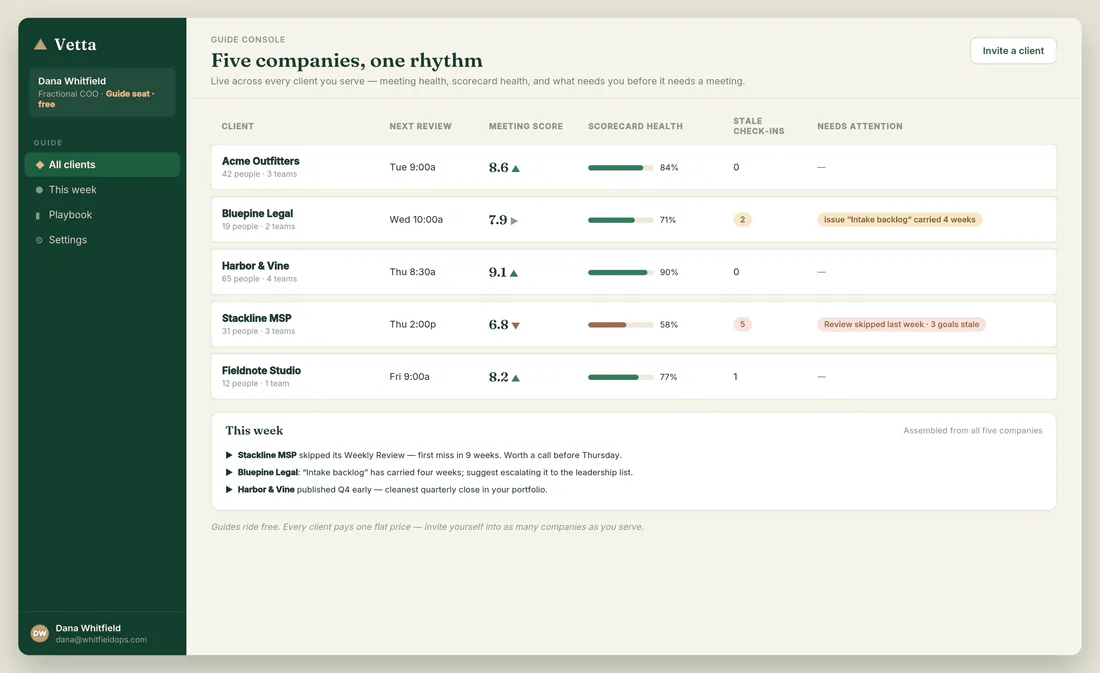
We'd rather design it with fractional COOs, implementers and coaches than guess at it. If you run rhythms for clients, that's an open invitation — the design-partner invite has the details.
Running EOS, Scaling Up, or your own system
This blueprint is deliberately doctrine-free, and that's not a dodge — it's the practical reality of a portfolio. You might run EOS® at one client, Scaling Up at another, and your own accumulated system at the third, because that's what each of those companies needed. The machinery underneath is the same in all three: a weekly meeting, a scorecard, owned commitments, and issues that don't get to hide. If you're choosing between the first two, here's how EOS and Scaling Up compare.
So use whatever language the client already speaks. If they say Rocks, L10® and IDS®, say Rocks, L10 and IDS. If they say goals and weekly review and issues, say that. The vocabulary is theirs; the discipline is what you're actually selling.
The economics of your practice
Worth being blunt about the money, since it's the part most blueprints skip.
Your margin is a function of unbillable time. Every hour rebuilding a scorecard template, chasing a client for numbers before a session, or reconstructing what happened in three weeks you didn't see — that's margin, gone. Standardising the install is worth more to your practice than raising your rate, because it compounds across every engagement you'll ever run.
There's a second-order effect too. Clients who keep the rhythm after you leave are the clients who refer you. A decayed rhythm is a neutral reference at best; a rhythm still running two years later is a case study that sells itself.
What this blueprint isn't
It isn't practice management. Nothing here handles your proposals, invoicing, pipeline, or client CRM — use whatever you already use.
It isn't a methodology or a certification, and it doesn't replace one. If you're a certified implementer of something, this is the operating layer underneath your method, not a competitor to it.
And it isn't a claim that every client needs the same thing. It's a claim that the machinery should be the same so your judgement can go into what actually differs.
This is a blueprint, not a case study. The guide side of Vetta is still in design, and when there are real results to publish, they'll appear with names attached.
What this looks like in Vetta
- Each client → their own workspaceTheir goals, their scorecard, their choice of goal mode. Nothing is shared between clients, ever, so no client sees another's numbers.
- You → a free seat, read-only todayJoin each client's workspace without adding a line to their bill, and see their goals, scorecard, issues and recaps. A fuller guide seat is in design — see below.
- The rhythm → the productThe Weekly Review holds the shape: six stages with timers, owners calling their own status, an automatic recap. It survives your absence because the client's own facilitator runs it, not you.
- Your Monday → the Guide ConsoleEvery client's meeting health, scorecard health, and stale check-ins on one screen. In design — see above.